

Working at Wistariahurst
Let’s go back in time and imagine you lived in Holyoke during the late 19th and early 20th centuries. While it’s easy to imagine being wealthy and living in luxury like the Skinner family, odds are you probably would have been working class and employed by the family either in their factories or in their home. A home this size required a lot of staff to keep everything running smoothly and to keep the family happy.
Servants Schedule
As a servant, you were expected to work up to 16 hours a day, six days a week. While some staff lived in their own homes, several lived at Wistariahurst, and living with the family meant you may be on call 24 hours a day. Below is the schedule staff had to keep for the family, all of which was managed by the butler or the housekeeper.
6:00 AM: Time to wake up! Start preparing the house for the family to begin their day.
8:00 AM: Eat a quick breakfast.
8:30 AM: The family eats breakfast.
9:00- 10:00 AM: The family starts their activities for the day. Cleaning, teaching, or chauffeuring begins.
10:15 AM-12:30 PM: Most staff prepare lunch.
12:30-1:45 PM: The family eats lunch; the staff will eat after serving the family, and then the staff cleans up after the family.
2:00-4:00 PM: Cleaning and mending for most staff; others start on dinner preparations and afternoon tea.
4:00-6:00 PM: Serve afternoon tea and continue cleaning and preparing rooms for sleep.
6:00-8:00 PM: Get ready to serve dinner; nannies prepare kids for bedtime.
8:00-10:00 PM: Family eats dinner; staff serves, begins cleaning up, and then gets bedrooms ready for the evening.
10:00-11:30 PM: Kitchen and maids ensure everything is clean; other staff makes sure the family is comfortable and sleeping, then the day is finally done.
Wistariahurst Staff
George “Geo” Brakey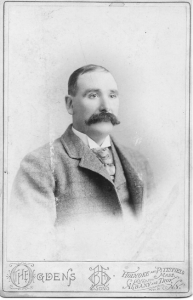
Role: Coachman, Chauffeur
Dates of Employment: 1894-1931 (37 years)
Born: July 29th, 1873. 1873 in Westville, NY
Died: September 21st, 1931. Holyoke, MA.
“Belle has been having a row with George because he was so shiftless as not to clean out the chimneys – he grows lazier each day – all he wishes to do now is drive an auto.”
-Diary entry from William C. Skinner, 1909
George “Geo” Brakey was born on July 29th, 1873, to Joseph and Elizabeth (Irwin) Brakey. He moved to Holyoke around 1891 and was employed by the Skinner family as a coachman starting in 1894. His duties extended far beyond horses and cars. He was responsible for maintaining the grounds and security of Wistariahurst. George, with his wife, rented a house at 264 Pine Street from the Skinner family. His house phone was connected to Wistariahurst, and you can see that phone in the Butler’s Pantry.
In 1909, William was on the verge of firing George but decided to let him “stay until spring anyway”. George did stay on and, in 1913, borrowed a horse from Wistariahurst while William was in New York City. William described the event in his journal, shown below. But even this incident did not end George’s employment.
“George took our beautiful black horse Stanley and went to dinner at his brother’s in Easthampton yesterday, and coming home drove into a hole and broke one of his [Stanley’s] back legs, so he had to be killed – I’m mad with George, he is so awful shiftless.”
George Brakey continued with his role as chauffeur at Wistariahurst until his health began to decline and he resigned a few weeks before he passed away in 1931, aged 58. His son, Walter, would go on to work for the Skinner family as their chauffeur for thirteen years after George’s death.
Hulda Klemm
Role: Nurse, Housekeeper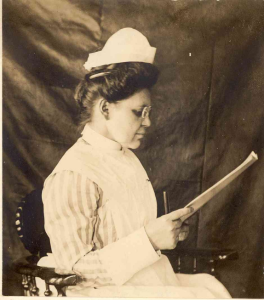
Dates of Employment: 1904-1950 (46 years)
Born: February 11th, 1869. Germany.
Died: January 28th, 1950. Holyoke, MA.
“She [Belle] is poorly enough yet, but we have Klemm taking care of her, and as we have confidence in her so think all will be well done.” – Sarah Skinner in a letter to Katharine Skinner Kilborne, 1907.
Originally from Germany, Hulda Klemm immigrated with her parents to the United States in August 1869 before settling in Holyoke. She graduated with the first nursing class to complete training at Holyoke Hospital in 1895 before being hired by the Skinner family in 1904. She watched over the health of William Skinner, his wife, Sarah, and their daughter, Belle. She maintained her position as the family nurse for over twenty-five years before the role of housekeeper was vacated.
She assumed the role of housekeeper in 1930, frequently writing to Belle Skinner to keep her informed of the things taking place at the Skinner Mansion. Like many long-term servants, Hulda Klemm never married or had children. Other employees of the Skinner family remember her as being “strict, but honest, fair.”
Throughout her life, she remained dedicated to her personal interest in hospitals and was a known member and supporter of the Holyoke Hospital Nurses Alumnae Association. Outside of her time working for the Skinners, she participated in the Holyoke Women’s Club and attended St. Andrew’s Evangelical and Reformed Church. In early 1928, Hulda died of heart disease in her room on the third floor shortly after serving Katharine Skinner Kilborne her afternoon tea. She is buried alongside her parents in Forestdale Cemetery, not too far away from the final resting place of the family she devoted her life to. She is remembered in a diary entry written by Katharine shortly after Hulda’s death,
“On Sunday morning January 29, 1950, Miss Klemm, the housekeeper and very dear friend of mine and my children, was found dead, lying peacefully on the floor. My family and children were her whole life. She was ‘faithful unto death.
Prudence LaGogue
Role: Personal Companion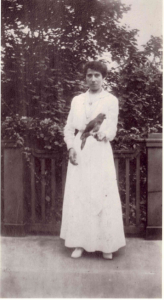
Dates of Employment: 1910-1928 (18 years)
Born: September 29th, 1881, Vierzon-Ville, France
Died: 1967, France
Prudence was born on September 29th, 1881, in Verizon-Ville, France, to Phillipe and Joséphine Feuillet. Before working as a personal companion, Prudence was engaged to be married and became pregnant. Unfortunately, her fiancé abandoned Prudence and her child, rather than marry her. At this time, being an unwed mother came with extreme stigma, and Prudence’s parents disowned her for several years, leaving her vulnerable with limited options. Her daughter, Cecile, was born in 1907, but Prudence had to place her into the care of an agency, similar to a modern-day foster home. Unwed mothers had very few options and no modern-day style daycare available, so placing her daughter in the care of an agency allowed her to work as a maid.
By 1910, Prudence was looking for new work opportunities, and Belle Skinner wanted to hire someone as a personal companion. Once Belle hired Prudence, she brokered a peace between Prudence and her parents. Cecile was then accepted by her grandparents, who would take care of her while Prudence was traveling and working. Belle would become Cecile’s godmother and pay any expenses of her, stating that she and Prudence would take care of the child together.
In addition to the regular responsibilities of a personal companion, she proved a crucial support to Belle in her restoration efforts in Hattonchâtel after it’s destruction during WWI. As the two formed a close relationship, Prudence accompanied Belle on her travels throughout the United States and Europe. When she would write letters to Belle, she would address her with “Mon bon vieux,” an affectionate term for a dear friend. They were so close that Prudence would buy gifts for Belle. Notice the framed photograph on the desk on the desk inside of the study. The dress Belle is wearing was purchased by Prudence, and it speaks volumes that Belle chose to be photographed in it.
The relationship between Prudence and Belle highlights the way working relationships could blur into the personal. The pair had been traveling back to Hattonchâtel when Belle passed away due to complications with pneumonia on April 9th, 1928.
Following Belle’s death, Prudence returned to Hattonchâtel and lived there for several years, helping to manage the work Belle had started. SShe also continued to have a close relationship with the Skinner family, visiting and often writing them letters, sharing fond memories of Belle. While she longed to return to the United States, Prudence lived the rest of her life in France and passed away in 1967.
Charles “Charlie” Linderme
Role: Chauffeur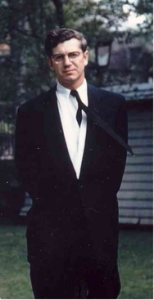
Dates of Employment: 1945-1959 (9 years)
Born: March 23rd, 1919. Holyoke, MA.
Died: March 1st, 1990. Holyoke, MA
“…There was always a million things to get done there. I never got ‘em done.”
-Charles Linderme, 1986
Charles “Charlie” Linderme was born in Holyoke on March 23rd, 1945, to Charles and Midred (Boudreau) Linderme. Linderme’s family was all employed at the Skinner Mills, which included his mother, father, and brothers. He was the only member of his family to never work in the mills. During WWII, he attempted to join the service, but managed to avoid serving. He held a variety of jobs around Holyoke, including working in a series of shops and mills as a laborer. His skills and experience led him to do “private work” as a messenger for a silk mill in 1940, most likely the Skinner & Son’s mills.
Charlie was married twice, having two children with his first wife and one child with his second wife. In addition to being a husband, father, and chauffeur, he was also a big-band musician, playing at various shows throughout Holyoke with the Charles Trio. His skill at the piano made him known as the “Man of the Keys.
From 1945 to 1959, Charlie was the chauffeur for the Skinner Kilborne family whenever they visited Holyoke. He used to call Katharine Skinner Kilborne “chief,” and he would later remember that she loved the nickname. He spent long hours driving Mrs. Kilborne, who hated flying and preferred to travel by car. He also claims that she did not like to go slow and especially hated being passed on the highway, so Charlie made sure that he was driving fast. When she moved back to Wistariahurst in 1950, following the death of her husband, Charlie became indispensable. During this time, he was given the responsibilities of managing the gardens and the small number of staff who remained, as the Skinner family began moving out of Holyoke. Regardless of whatever role he had to fill that day at Wistariahurst, he would always be dressed in a black suit with a white shirt.
Charlie was paid $70 a week plus tips, and anything extra that he could add to his expense count, a nice living at that time. In 1959, when Mrs. Kilborne left Wistariahurst to the city, she remained as loyal to Charlie as he was to her and ensured he would remain as the permanent caretaker. He lived on-site at Wistariahurst, and Holyoke also hired his brother, Brad. In 1979, however, the city had to lay off one of the Brothers Linderme. Charlie left, as he could make a living playing music. Later on, he became a chauffeur for Senator John F. Kennedy until he became president. He passed away in Springfield on March 1st, 1990. He is buried at Forestdale Cemetery in Holyoke.
Anthony “Tony Bosky” Neidbalski
Role: Gardener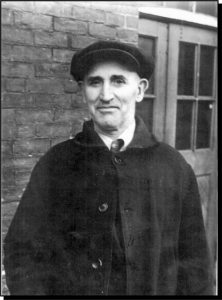
Dates of Employment: 1929-1946 (25 years)
Born: November 1879. Poland
Died: October 9th, 1946. Holyoke, MA.
“I would rather grow flowers, but if it will help my country, I will raise vegetables.”
-Tony Bosky, Holyoke Transcript, August of 1943.
Anthony Neidbalski, known as Tony Bosky, worked for the Skinner family for seventeen years. He was born to a Polish family in November of 1879. Tony, at one point, had owned property along Route 5 near the old Atwoods Airport and was self-employed as a farmer during World War I.
Unfortunately, Tony lost his land and fortune and had to seek other employment. In 1920, he worked as a sorter at a tobacco shop before moving on to work at Smith College as a gardener. His personal and professional experience with farming and gardening equipped him to work for the Skinner family in the late 1920s.
During his time at Wistariahurst, Tony lived in South Hadley with his parents, siblings, and his grandson, Paul. Tony and Paul shared a room, often listening to the radio for war reports. When he wasn’t with his family or tending to his own garden at home, he worked for the family six days a week and maintained both the formal and, later on, a victory garden. Victory gardens, or war gardens, were vegetable patches that helped offset the food rationing during WWII.
He also made sure there were fresh flowers ready every morning for the Skinner family, and helped inside the house by polishing the floor using a brick covered with carpet.
In 1946, while pruning a tree along Beech Street, he fell from his ladder, impaling himself on the fenceline. At the time of his death, Tony’s family recalled that he loved the gardens he tended to so much that he asked to be buried with seeds from Wistariahurst in his pocket. His family honored his request before he was laid to rest in the Polish section of the Mater Dolorosa Cemetery.
“…He was held in great esteem by the Skinner family, and we shall miss him. May God reward him for his faithfulness.” -A sympathy letter from Katharine (Skinner) Kilborne to Tony’s family.
Alfred Paganini
Role: Chauffer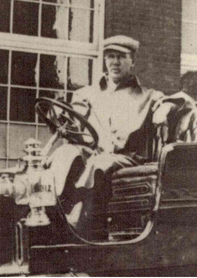
Born: November 3rd, 1888. Uruguay, South America.
Years of Employment: 1926-1944 (18 years)
Died: August 9th, 1963. NYC, New York.
Alfred Paganini, born on November 3rd, 1888, worked as a chauffeur for William Skinner from 1926 to 1944, driving him around France, New York, and Holyoke. His life story contains many embellishments; he claims to be from France, but his WWI draft card lists Uruguay as his place of birth.
In a 1936 interview with the Springfield Daily Republican, Alfred shared stories about his life, including moving to England at 18 and claiming to be an auto racing driver who won the 1904 James Gordon Bennett Cup
But the winner was actually a well-known driver, Léon Théry. He also claimed to be a WWI lieutenant, but he was a Sergeant. His assertion of being a pilot was contradicted by records showing he performed technical support duties. Additionally, he mentioned being fined for speeding at 120 mph, but it was later revealed he was stopped on Franklin Street and fined $5 for ignoring police orders.
Alfred’s life reflects an era where public record access was limited, allowing for potential fabrications. Despite the discrepancies in his life story, he was valued by Mr. Skinner during his employment. He passed away on August 9th, 1963, in New York City.
Ada Peoples
Role: Cook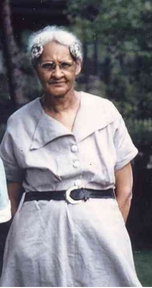
Dates of Employment: 1940s-1959 (10+ years)
Born: February 12th 1883. Tazewell, Virginia
Died: March 12th, 1961. Tazewell, Virginia
“I never heard her raise her voice…I don’t think it was possible for her to.”
-John Byrnes, Milk Delivery Man
Ada Peoples was the last cook at Wistariahurst, and the only Black staff member the research has found. She was born in 1883 in Tazewell, Virginia, to Miles and Mary Cecil. She married John Peoples around 1905. Together they raised Ada’s eldest child, Katherine Cecil, before having their first child together, Mary, in 1916. In census records, Ada is listed as having no formal education, but being able to read and write English. She was employed as a cook for a private family in Jeffersonville, Virginia in 1930. Sometime after that, Ada moved to Western Massachusetts.
After Ada moved to Holyoke, she was employed by Katharine Skinner Kilborne. Unlike most cooks, Ada lived onsite and worked at Wistariahurst from 1940 to 1959. The family really enjoyed her cooking, especially her recipes for broiled chicken and fried bananas. The metal mold that you see on display in the Butler’s Pantry was used by Ada for making gelatin puddings or cakes, or boiled puddings (often referred to by the French name, Charlotte cake).
The family enjoyed her Maple Charlotte that was made in that tin, and Ada gifted it to the family as a token of her appreciation. In her free time, she cared for her collection of Colonial-era pots and pans, family heirlooms, passed down to her after generations of use.
When Katharine and her children donated Wistariahurst Museum to the City of Holyoke, Ada moved back to her hometown. She passed away on March 12, 1961. Her character and food are remembered fondly by family, friends, and co-workers at Wistariahurst.
Harriet “Hattie” Riley
Dates of Employment: 1881-1926 (47 years)
Role: Maid, Housekeeper
Born: March 2nd, 1848 or 58. Harrowgate, England
Died: December 14th, 1926. Northampton State Hospital
Harriet “Hattie” Riley was born on March 2nd, 1848, in Harrowgate, England, to Edward and Ann (Lofthouse) Riley. She grew up taking care of her many siblings while her parents worked, having to sacrifice receiving an education to help her family. 1868, Hattie, her three brothers, and her parents immigrated to the United States before settling in Holyoke.
“Beautiful day – left Holyoke in auto at 2:07 and in NY house at 9:15. Hattie Riley who has been in our employ for 30 years or more, fell and broke a rib.” -Diary Entry from William C. Skinner on June 22nd, 1908.
Before her employment with the Skinner family, Hattie worked as a dressmaker. On February 1st, 1881, Hattie married her first and only husband, George Beauregard. Their unnamed son was born a few weeks later, but would die when he was three days old from complications of lockjaw. He was never named, and Hattie and George divorced in 1890. Shortly after the loss of her child, Hattie began living with and working for the Skinner family. She started working as a maid before she was promoted to the Housekeeper role in the early 1900s.
Hattie would work for the Skinner family for forty-seven years before she began to suffer from physical ailments and senile psychosis (paranoia). The Skinner family helped arrange for her care at the Northampton State Hospital and, after her death, buried her in the family plot at Forestdale Cemetery in Holyoke. These acts demonstrate the close relationships that were developed through years of devotion and how the Skinners treated Hattie like family.
Ellen “Nellie” Wright
Role: Chambermaid, Nursemaid, & Personal Assistant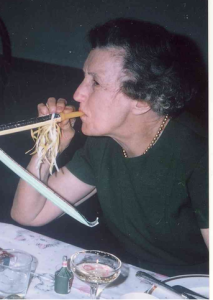
Dates of Employment: 1910-1968 (58 years)
Born: December 14th, 1888
Died: March 1980, in Enfield, England.
“Nellie Wright is my greatest joy in the home. She does everything for me and is always pleasant and very efficient.”
-Diary entry from Katharine Skinner Kilborne, 1944
Ellen “Nellie” Wright started working for the Skinner family in 1910 as a chambermaid. Eventually, Nellie was promoted to the position of nursemaid to Katharine’s first son, R. Stuart Kilborne. Later on, Nellie would work for the Kilborne family as a maid and chaperone to their daughter, Elizabeth. The youngest of Katharine’s grandchildren and great-grandchildren called her “Nellie-bell.”
Katharine employed Nellie as her personal companion after her husband’s death in 1950. Nellie assisted Katharine in her daily activities for the last eighteen years of Katharine’s life. Nellie lived at Wistariahurst in the 1950s and moved with Katharine to New York City in 1959. She never married and moved back to the United Kingdom, her home country, in 1968 upon Katharine’s death. Katharine declared in her will that Nellie be given the annual interest from a bequest of $30,000. Family members remember her as being unfailingly loyal to Mrs. Kilborne. Nellie passed away in March of 1980, aged 91.